“Mission” and “Vision:” Part III

Thanks for reading these posts; I don’t take it for granted. Though I’m sharing some generally agreed upon definitions and summarizing some of the work we’ve been doing together I don’t imagine that my perspective on these things is the only one that matters. I value conversation with you about any and all things pertaining to our common life in Christ.
In this week’s post, I draw your attention to the topic of “vision,” in quotes because this is the kind of sight we call “insight,” literally in-sight, that of the imagination, that of a hoped-for reality in which the world is a better place and we’ve had some part in making that so. Imagining our common future is a powerful practice.
Famously, the old King James Version translated Proverbs 29:18 “where there is no vision the people perish.” Newer translations phrase it something like “without prophetic insight, people cast off restraint/lose their way.” The sense is close to the same; the newer translation hews closer to the meaning that it isn’t just some “imagined future” we need, but something inspired, something that God has revealed to us as we’ve prayed and considered together.
If our mission answers the question, “what is uniquely ours to do together?” our vision is the answer to the question, “What will we achieve if we actually live our mission over the next 3-5, or longer term, 5-10 years?” There’s an old adage that goes, “we usually overestimate what we can achieve in one year, but we vastly underestimate what we might accomplish in ten years.”
In the Church this is doubly true since we are explicitly called to join our imagining and our service with God’s power and leading. This is the truth of the scripture that I quoted last week to the effect that “unless the Lord builds the house, the labourers labour in vain.” If we fail to partner with God’s Spirit, we will flail and flounder, but we also remind ourselves that it’s precisely because the Lord desires to build the house, and build it in a certain way, reflecting the life and ministry of Jesus, that we can have a quiet, humble, confidence that our discernment and our labour in the Lord is not in vain!
To use an example of this process in action I point you to the St. Paul who, when he was called by God was given the mission of preaching in the synagogues to the Jews and in the marketplaces to the Gentiles. This he did wherever he went. From his letters and from the book of Acts we can discern that his vision was of a series of house-churches dotting the northern rim of the Mediterranean basin. Living his mission led him to achieve, if not the fullness of his vision (we know he desired to go to Spain but don’t know if he ever got there), then at least partway there.
Eastern philosophy has the saying “if you aim at nothing, you hit nothing;” more recently Jordan Peterson has used the phrase, “you don’t get what you don’t aim at.”
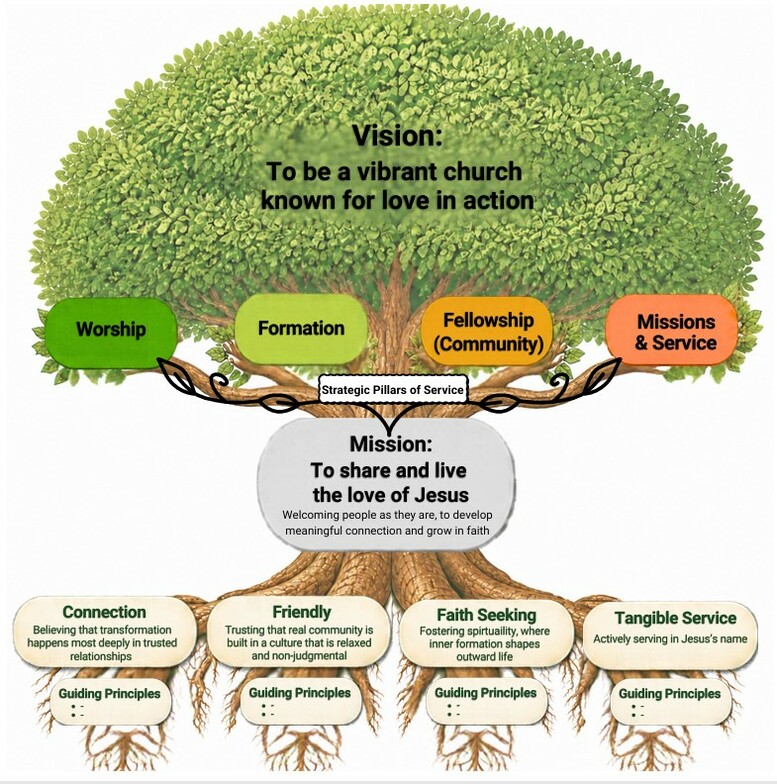
So what are we aiming at? If St. Philip exists to share and live the love of Jesus (our mission, see last week’s post), what do we believe would happen if we lived into that over the next 3-5 or 5-10 years? What do we “see?” What in-sight do we imagine? What Vision do we glimpse? If you allow your eye to drift to the diagram of the tree at the bottom of this post you’ll note a simple phrase that is pasted on the tree’s canopy: “To be a vibrant church known for love in action.”
Like our mission, the wording of our vision has been carefully considered. “Vibrant” refers to a quality of liveliness that we hope will characterize all our ministries and structures; it suggested a “fullness” of expression, and, in my mind at least, asks us to imagine an intergenerational parish whose diverse people, in age, in socio-economic background, seek to live in a way that expresses harmony in difference. The word also suggests energy (vibrate!) in which there are “pop-up” realities that spring up from the parish, not just in terms of ministries that meet needs but in ways we might celebrate and enjoy God’s goodness.
“Known” suggests a reputation; not something we would “trumpet” but something that “happens” because the community is living authentically. Authentic communities feel safe but that doesn’t mean it isn’t challenging. Authentic Christian community takes risks for the sake of God’s Good News but does so in a way that is collaborative.
“Love in action” connects directly to our mission statement (live the love of Jesus) but here the focus is on the tangible results that will arise as we live this love. What does “love in action” mean to you?
By putting the statement in “the canopy” the vision statement is saying, “here is what a mature expression of our mission statement, won over time, will look like.” You will have noticed that the mission feeds the main tree limbs/pillars of Worship, Formation, Fellowship/Community, and Mission/Service. Whatever “love in action” means it will arise, not just from one of these limbs, but from all of them, either in tandem or separately.
Our vision statement is not overly prescriptive; it leaves room for interpretation and application that might surprise us as “the situation on the ground” changes. The canopy of the tree is that part of the tree that takes up the most space; it is that space where “the different birds” might dwell and nest; it is the place of diverse flourishing.
What “love in action” might look like over time will look different in different locales. As we consider which building we may want to inhabit going forward we may want to use our imagination to ask “What is possible in each of these facilities?” We may want to ask, “What might need to change in each of these buildings if we were to live into our vision with the kind of fullness I’ve described?” We may want to ask “What financial and human resources are available to us in order to fulfill a vision that speaks of St. Philip becoming even more of a vibrant church than it presently is?”
Blessings on your week!
header photo by Mike Holford on Unsplash
Click image to view larger